SISTEMAS OPERATIVOS
Pesquisa sobre os diversos OS disponíveis no mercado.
Este é o resultado de uma pesquisa feita a nível de INTERNET sobre os diversos sistemas operativos disponíveis para correrem em maquinas que vão desde os sistemas de multiprocessadores até aos sistemas RISC.
NOTA:
Os textos que acompanham os SO aqui mencionados são os originais. Alguns são de folhetos publicitarios e muitos estaõ em inglês. A não tradução das descrições deve-se ao facto de uma grande parte das palavras serem palavras-técnicas e não haver tradução sem se deturpar o seu significado, assim foram deixados intencionalmente os textos na sua lingua original.
 Voltar à pagina anterior
BS2000/OSD-BC
OSD-SVP
DEBIAN
GNU
JOS
LINUX
SOLARIS
FreeBSD
GUIDE
HURD
INFERNO
KeyKOS
EROS
Linx
MOSIX
OpenBSD
QNX
RTEMS

 Open Server Dimension - Basic Configuration
Current version: V4.0
BS2000/OSD®-BC V4.0 is a multiprogramming/multiprocessor operating system employing a virtual storage concept and based on standard microprocessors and /390 architecture. It runs on monoprocessor and multiprocessors systems (up to 15-way). In multiprogramming mode, up to 4096 tasks (including system tasks) can be managed simultaneously. A 2-Gbyte virtual address space for user and system programs and data is available to each task. On ESA systems, each task can also make use of additional 2-Gbyte dataspaces. Multiple tasks can also access these dataspaces (shared mode). Real main memory can be a multiple of 2 gigabytes. The system is capable of addressing memory in terabyte ranges. The system maps the virtual address spaces onto the real memory that is actually available.
The address spaces allocated to individual users are protected against unauthorized access by other users. Exceptional user friendliness is achieved by means of automatic resource and data management.
The security functions which have been evaluated as F2/Q3 according to the classification of the security criteria catalog issued by the German Federal Agency for Security in Information Processing, are available in BS2000/OSD-BC V4.0.
Voltar ao topo
Open Server Dimension - Server Value Package
Current version: V2.0B
Announced version: V3.0
OSD Server Value Package is the BS2000 operating system supplemented by additional system-oriented software to provide all-round functionality for the RISC-based SR2000 server family.
The operating system is based on the current version (V3.0) of BS2000/OSD-BC, the code of which was ported onto RISC hardware in order to ensure maximum possible performance. Software tools developed specifically for porting make it possible to provide system software with the same level of functionality for RISC- and /390-based systems. The firmware layer integrated in the system ensure that existing custom applications can continue to operate (insofar as they are based on currently released software products).
Voltar ao topo

WHAT is Debian?
Debian is a free, or Open Source, operating system (OS) for your computer. Debian is kernel independent. It currently uses the Linux kernel but work is in progress to provide Debian for other kernels, using the Hurd. The Hurd is a collection of servers that run on top of a microkernel (such as Mach) to implement different features. The Hurd is free software produced by the GNU project. A large part of the basic tools that fill out the operating system come from the GNU project; hence the names: GNU/Linux and GNU/Hurd. These tools are also free. Of course, the thing that people want is application software: programs to help them get what they want to do done, from editing documents to running a business to playing games to writing more software. Debian comes with over 2250 packages (precompiled software bundled up in a nice format for easy installation on your machine) -- all of it free.
It's a bit like a tower. At the base is the kernel. On top of that are all the basic tools. Next is all the software that you run on the computer. At the top of the tower is Debian -- carefully organizing and fitting everything together so it all works together.
What hardware is supported?
Almost all common hardware is supported. If you would like to be sure that everything you have is supported, check out the Linux Hardware Compatibility HOWTO.
There are a few companies that make support difficult by not releasing specifications for their hardware. Even if you have a commercial driver, you can run into problems if the company later goes out of business or stops support of the hardware you have. To ensure that you don't run into such problems, check out our Open Hardware Specification.
Voltar ao topo
|

|
GNU
GNU's Not Unix |
The GNU Project and the Free Software Foundation, GNU, FSF, are since 1983, developing the free Unix-like operating system GNU so that computer users can have the freedom to share and improve the software they use. The GNU Project was launched in 1984 to develop a complete free Unix-like operating system -the GNU system.
Variants of the GNU system, which use the kernel Linux, are now widely used though these systems are often referred to as, they are more accurately called
-GNU/Linux
The GNU Project has been a major influence on free software development for more than a decade, creating a myriad of important tools such as robust compilers, powerful text editors, and even a fully functional operating system. The project was started in 1984 by MIT programmer Richard Stallman to create a free, UNIX-like operating environment. Since then, thousands of programmers have joined in the effort to produce free, high quality software which is accessible to everyone.
How to get GNU software
Buy copies on CD-ROM from the FSF. This helps provide the funds for the GNU Project.
Our three CD-ROM sets include source code for all GNU software, GNU compiler tools executable on ten common platforms, and a larger selection executable on intel-microsoft platforms.
Get it by FTP. By FTP we provide source code for all GNU software, free of charge.
(Please also make a donation to the FSF, if you can, to help us write more free software.)
Get a copy from a friend.
(Please also make a donation to the FSF, if you can, to help us maintain free software.)
Buy a computer with a wholly free GNU/Linux system preinstalled from one of the companies that can offer this.
Voltar ao topo
|

|
A Free Java™ Based Operating System |
The JOS Project is a collaborative undertaking by an international group of Java™ programmers and enthusiasts aimed at the creation of a free and open Java™ based Operating System (JOS).
JOS is an Open, Portable, and Dynamically Extensible Java(tm) based Object Operating System, based on a configurable layered architecture.
By 'Open', it is meant that each layer of JOS is an implementation of a coherent set of 'interfaces' which clearly define and provide a set of services and functionality to a client object or application. As a system composed mainly of Java (tm) components, JOS is a 'Portable' operating system to the extent that only minimal host specific implementation effort is required for the transition of JOS from any given platform to another. And by fully utilizing the dynamic nature of the Java(tm) platform, JOS is designed to be fully extensible and configurable at run-time, making it a Dynamically Extensible operating system. Finally, as an operating system, JOS is not merely a system implemented using an object oriented language; JOS presents an 'Object Oriented' personality from its lowest layers, up to the application developer, and beyond to the user.
The choice of an operating system selectively narrows the range of applications available for use by its user. This fact alone has been greatly responsible for the accelerated trend towards the convergence of the personal computing market to a single family of operating systems. A fate not entirely favorable to both the developer or the user community. Overcoming the strangle hold of the prevalent OS has been a great contributing factor in the wild (and sometimes emotional) embrace of Java(tm) by the software development community. As an interpreted byte code system, Java applications can run with little or no modification on any platform which supports an implementation of the Java(tm) Virtual Machine. As long as the integrity of the Java(tm) platform can be maintained and its virtual machine and APIs widely distributed, the choice of an operating system no longer limits the user to a host specific set of applications.
JOS has been designed to address the desire of what is probably a great many software designers who have always wanted to design and build their own object operating systems. As a object oriented tool kit for creation of specialized or experimental object operating systems, JOS will also provide an invaluable educational tool For this reason, the lowest layer of JOS is intended to function as a Open Virtual Platform (tm), with a fully functional Java virtual machine, an open byte code instruction set, and a 'native' interface to core resources expressed in Java(tm).
Morphology
Keeping true to the original impulse of the JOS collaborative effort, JOS is intended to grow from a functional operating system bootable from a portable storage medium no greater than 1.4 MB in size to greater functionality.
The essential initial development is the specification, design, and implementation of the JOS Open Virtual Platform(tm), which is the platform specific lower layer of JOS. The proposed initial host platform is the 486 microprocessor family.
If technically possible, it is desirable that the JOS Open Virtual Platform(tm) interface APIs be specified as soon as it is possible, allowing for the possibility that the JOS System Services Layer effort can be undertaken concurrent with the core layer implementation.
Where is the JOS operating system?
Well its not ready for use yet (we're still building it). However, a useful operating system is not just a kernel. It requires many support utilities, applications, and games. Many JOS members have been working on these utilities, and since they are written in Java, you should be able to use most of them with any Java Virtual Machine (JVM's are available for practically every existing operating system). For a quick summary of the running software we have right now visit the GettingStartedProducts page. To learn more about our kernels and their current status, visit the KernelSummary.
What Sub-Projects are in support of the JOS Project?
- JJOS is the active kernel project.
- decaf is a Java virtual machine build on top of JJOS.
- Classpath is a GNU project to implement the JavaAPISpecification, which we intend to integrate. This will need to be modified to rely on:
- JOSCore, the DeviceArchitecture, the TCPIPStack, the Registry, etc.
- JADE is to be our user interface architecture.
- Jext is our standard text editor and will be distributed with JOS. Other utilities await the creation of our base API's before they can be built.
- Other applications are being built on top of the JavaAPISpecification for distribution with JOS. See the GameGroup and ApplicationsGroup for details.
Voltar ao topo
|

|
LINUX |

|
Linux is a free Unix-type operating system originally created by Linus Torvalds with the assistance of developers around the world. Linux is an independent POSIX implementation and includes true multitasking, virtual memory, shared libraries, demand loading, proper memory management, TCP/IP networking, and other features consistent with Unix-type systems.
It was initially created as a hobby by a young student, Linus Torvalds, at the University of Helsinki in Finland. Linus had an interest in Minix, a small UNIX system, and decided to develop a system that exceeded the Minix standards. He began his work in 1991 when he released version 0.02 and worked steadily until 1994 when version 1.0 of the Linux Kernel was released. The current full-featured version is 2.2 (released January 25, 1999), and development continues.
Linux is developed under the GNU General Public License and its source code is freely available to everyone. This however, doesn't mean that Linux and it's assorted distributions are free -- companies and developers may charge money for it as long as the source code remains available. Linux may be used for a wide variety of purposes including networking, software development, and as an end-user platform. Linux is often considered an excellent, low-cost alternative to other more expensive operating systems.
Due to the very nature of Linux's functionality and availability, it has become quite popular worldwide and a vast number of software programmers have taken Linux's source code and adapted it to meet their individual needs. At this time, there are dozens of ongoing projects for porting Linux to various hardware configurations and purposes.
Linux Compatibility
Linux runs succesfully on most computers, laptops, and platforms. There are several projects underway to port Linux to other hardware configurations. An overview of hardware compatibility resources are listed below:
- Supported PC-based CPUs include:
- Intel/AMD/Cyrix 386SX/DX/SL/DXL/SLC
- Intel/AMD/Cyrix 486SX/DX/SL/SX2/DX2/DX4
- AMD K5, K6, K6-2
- Cyrix 6x86, 6x86MX
- Intel Pentium, Pentium Pro and Pentium II
- IDT WinChip C6
- Symmetrical Multiprocessing (multiple CPUs)
- more
- Supported non-PC based platforms include:
- Digital Alpha
- Sun SPARC
- Macintosh
- more...
- Most laptops and notebooks are supported.
Click here to get your Linux Kernel Archives
Voltar ao topo
|
|
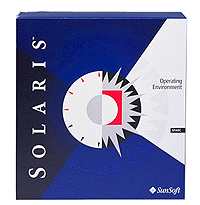
SOLARIS |
A PLATAFORMA FLEXÍVEL DE SOFTWARE PARA AS ARQUITECTURAS EM REDE
Solaris é uma solução multithreading, com elevada capacidade para realização de tarefas simultâneas e multiprocessamento. É escalável numa grande variedade de plataformas, desde computadores portáteis a PCs, estações de trabalho, servidores de médio e grande porte. Para além da sua tremenda escalabilidade - a mesma versão que corre num servidor monoprocessador corre também num servidor central de dados de 64 processadores, o Solaris é ideal como plataforma de desenvolvimento aplicacional, sendo hoje o ambiente de eleição dos principais construtores de bases de dados: Oracle, Informix e Sybase.
Soluções
Desktop
Solaris Desktop inclui ferramentas de produtividade tais como o e-mail, calendário passível de partilha, e uma janela de visualização para os utilizadores indivuduais ao mesmo tempo que proporciona aos programadores que desenvolvem aplicações um poderoso ambiente de desenvolvimento. Todas estas características são suportadas pelo CDE (Common Desktop Environment), que proporciona aos utilizadores utilizando diversas plataformas um ambiente standardizado e com base em janelas menus.
As implementações X86 e Pentium do Solaris oferecem uma solução adicional para aplicações baseadas em redes de PCs. Com esta versão do Solaris, as empresas podem operar LANs e tirarem partido do poder dos microprocessadores Intel numa rede flexível e de baixos custos.
Soluções com servidores de rede
Solaris permite-lhe construir uma solução de administração de clientes de modo a gerir centralmente grandes redes de PCs. Com ele, os administradores de rede podem administrar qualquer PC ligado ao servidor e estipular políticas e regras, gerir contas e directorias. Mecanismos de visualização amigáveis são geridos num servidor centralizado Solaris, proporcionando total segurança e permitindo aos administradores responderem prontamente às solicitações dos utilizadores da rede sob sua gestão.
Pode coexistir com redes NetWare da Novell. Os clientes conectados ao NetWare podem ligar-se ao servidor Solaris, sem terem que se desligar do servidor NetWare. Para além disso o servidor Solaris pode conectar LANs, WANs com produtos IPX/SPX e TCP/IP integrado.
Soluções com servidores empresariais
Ao proporcionar aos utilizadores da rede acesso a poderosas aplicações distribuídas, ligação à Internet e extensas opções de administração, o Solaris proporciona às empresas uma base comum para ligar as suas múltiplas ilhas dispersas no reino da computação.
Solaris funciona como o motor de elevada performance que os processos transaccionais exigem. Também proporciona a disponibilidade e fiabilidade que as aplicações de missão crítica requerem. Esta é uma das muitas razões porque o Solaris foi escolhiso como a plataforma de eleição para os sistemas de bases de dados relacionais. A escalabilidade do Solaris fez dele a plataforma líder para servidores multiprocessamento.
Solaris proporciona as características requeridas para manipular, armazenar e fazer o backup de grandes volumes de dados. Para além de satisfazer requisitos de alta disponibilidade, as implementações do Solaris suportam clustering e hot plugging para prevenir falhas do sistema. Na verdade, de acordo com ratings RAS (reliability, availability, serviceability), o Solaris está entre os ambientes de eleição para a computação empresarial.
Soluções Internet
Como sistema operativo robusto contruído sobre uma rede TPC/IP, o Solaris é a base para o acesso à Internet, segurança, publishing e comércio electrónico.
As soluções de acesso à Internet Solaris também facilitam o acesso à Internet via desktops. Os utilizadores podem pois partilhar ficheiros, trocar email e navegar na World Wide Web. O Solaris é também a base para a Java, a linguagem interactiva de programação na Internet
Com as soluções Solaris não há necessidade de grandes conhecimentos UNIX. As soluções Internet Solaris não afectam o ambiente do utilizador ou comunicações LAN, por iso não importa que plataforma desktop esteja instalada, o Solaris é um ambiente poderoso e seguro para capitalizar no futuro da computação de rede.
Voltar ao topo
FreeBSD
FreeBSD is one of several free, monolithic BSD 4.4-lite derivative operating systems. It provides full UNIX support, including networking, X Windows, and almost all other normal UNIX services.
Voltar ao topo
GUIDE
Guide (Grenoble Universities Integrated Distributed Environment) is an object-oriented distributed operating system for the development and operation of distributed applications on a local area networks connecting workstations and servers. Guide is a joint project of Bull and the IMAG Research Institute (Universities of Grenoble), which have created the Bull-IMAG joint Research Laboratory. It also has strong links with the COMANDOS Esprit Project (Construction and Management of Distributed Open Systems) and the BROADCAST Esprit Basic Research project
Voltar ao topo
HURD (Free Software Foundation GNU Project)
Related to: Mach
The HURD is the operating system being developed by the Free Software Foundation as the basis for the GNU Project, which has already produced such well known tools as Emacs and GCC. The Hurd is a personality for the Mach micro-kernel which exports a bevy of services to the application. The Hurd will provide the standard UNIX interface, but should also be much more flexible than standard UNIX.
Voltar ao topo
Inferno
Inferno(tm) is a new network operating system and programming environment to deliver content in a rich environment of heterogenous networks, clients and servers. The Inferno system includes the Inferno kernel, the Limbo(tm) programming language, reference APIs that include interfaces for networking and graphics, network protocols, security and authentication, and various toolkits. Inferno was developed by members of the Computing Sciences Research Center of Bell Laboratories, the research arm of Lucent Technologies.
Voltar ao topo
KeyKOS
KeyKOS is an operating environment for S/370 computers which provides a high level of security, reliability, performance, and productivity. It allows emulation of other environnzens such as VM, MVS, and POSIX. Development of KeyKOS ceased in 1990. Many of the ideas of this system have been carried forward into EROS
Voltar ao topo
EROS (University of Pennsylvania) Group Members
EROS (Extremely Reliable Operating System) is a new operating system being implemented at the University of Pennsylvania. The system merges some very old ideas in operating systems with some newer ideas about scheduling and performance. The result is a small, secure, high-performance operating system that provides transparent orthogonal persistence coupled with microkernel-style critical paths, including a high performance IPC subsystem.
Voltar ao topo
Lynx (Lynx Real-time Systems)
LynxOS is a proprietary UNIX-like real-time operating system. LynxOS looks and feels like UNIX from the user/programmer point of view. It was developed from the ground-up with high performance, deterministic hard real-time response in mind. Although LynxOS is conformant with POSIX 1003.1 it is not derived from any AT&T/USL/Novell source code. The OS is in effect a complete re-implementation of UNIX from a real-time perspective.
Voltar ao topo
MOSIX (Hebrew University, Jerusalem, Israel) Group Members
A solution to the NOW problem is now available in the form of a multicomputer operating system enhancements, called MOSIX. MOSIX is an enhancement of UNIX which allows users to use the resources of a NOW configuration, without any change to the application level. By using transparent, dynamic process migration algorithms, MOSIX enhances the network services, i.e. NFS, TCP/IP, of UNIX, to the process level, by supporting load balancing and a dynamic work distribution (leveling) in clusters of homogeneous computers.
Voltar ao topo
OpenBSD
Yet another group pushing a free BSD-Lite derivative. This group splintered off of the NetBSD project, for reasons unclear to me, although I'd guess perhaps becuase NetBSD wasn't pushing out regular releases fast enough, and FreeBSD wasn't supporting non-x86 platforms. The splintering of BSD people has effectively killed any chance of BSD beating Linux, expecially given the good work porting Linux to other platforms.
Voltar ao topo
QNX
A micro-kernel, distributed, real-time, fault-tolerant, POSIX-certified OS for the x86. QNX adopts the approach of implementing an OS with a 10 Kbyte micro-kernel surrounded by a team of optional processes that provide higher-level OS services. QNX is fully distributed, with all system interfaces network transparent. QNX has successfully been used in tiny ROM-based embedded systems and in several-hundred node distributed systems.
Voltar ao topo
RTEMS (Redstone Military Arsenal)
RTEMS is a real-time operating system for embedded computer systems with the following features:
- support for homogeneous and heterogeneous multiprocessor systems
- event-driven, priority-based, preemptive scheduling
- optional rate monotonic scheduling
- intertask communication and synchronization
- responsive interrupt management
- dynamic memory allocation
Voltar ao topo
Última revisão: 4/12/99